Tuningchip logotype
Adblue

AdBlue off
A solution for trouble-free driving

10 Dec 2025
Are you tired of recurring warning lights and expensive repairs that depend on your car's AdBlue system?
Then we can offer the service "AdBlue off / Adblue delete an effective solution that makes use easier and more cost-effective. By turning off the
AdBlue system on the vehicle, you avoid troublesome sensors and constant refilling of AdBlue fluid, without affecting either the vehicle's basic function or safety.
PRICE 4990:-

What is AdBlue & why is it used?

AdBlue is used in modern diesel cars to reduce nitrogen oxides (NOx) and contribute to cleaner air and a smaller environmental impact. This is something that has made it possible for car manufacturers to continue offering diesel engines at a time when low emissions requirements are a bottleneck for type approval. However, for you as a car owner, this means a system that must be maintained in order for the car to function as intended.

AdBlue consists of 32.5% urea and 67.5% distilled water and is injected into the car's exhaust system just before the exhaust reaches the SCR catalytic converter. It is important to know that AdBlue is not urine and cannot be replaced with urine, water or other liquids - these will damage the system directly.

Through selective catalytic reduction (SCR), AdBlue is converted into ammonia when injected into the hot exhaust system. In the SCR catalyst, the ammonia reacts with the nitrogen oxides (NOx) and converts them into nitrogen gas and water vapor, which greatly reduces emissions and allows modern diesel cars to meet today's emissions requirements.

But how does it work in practice?
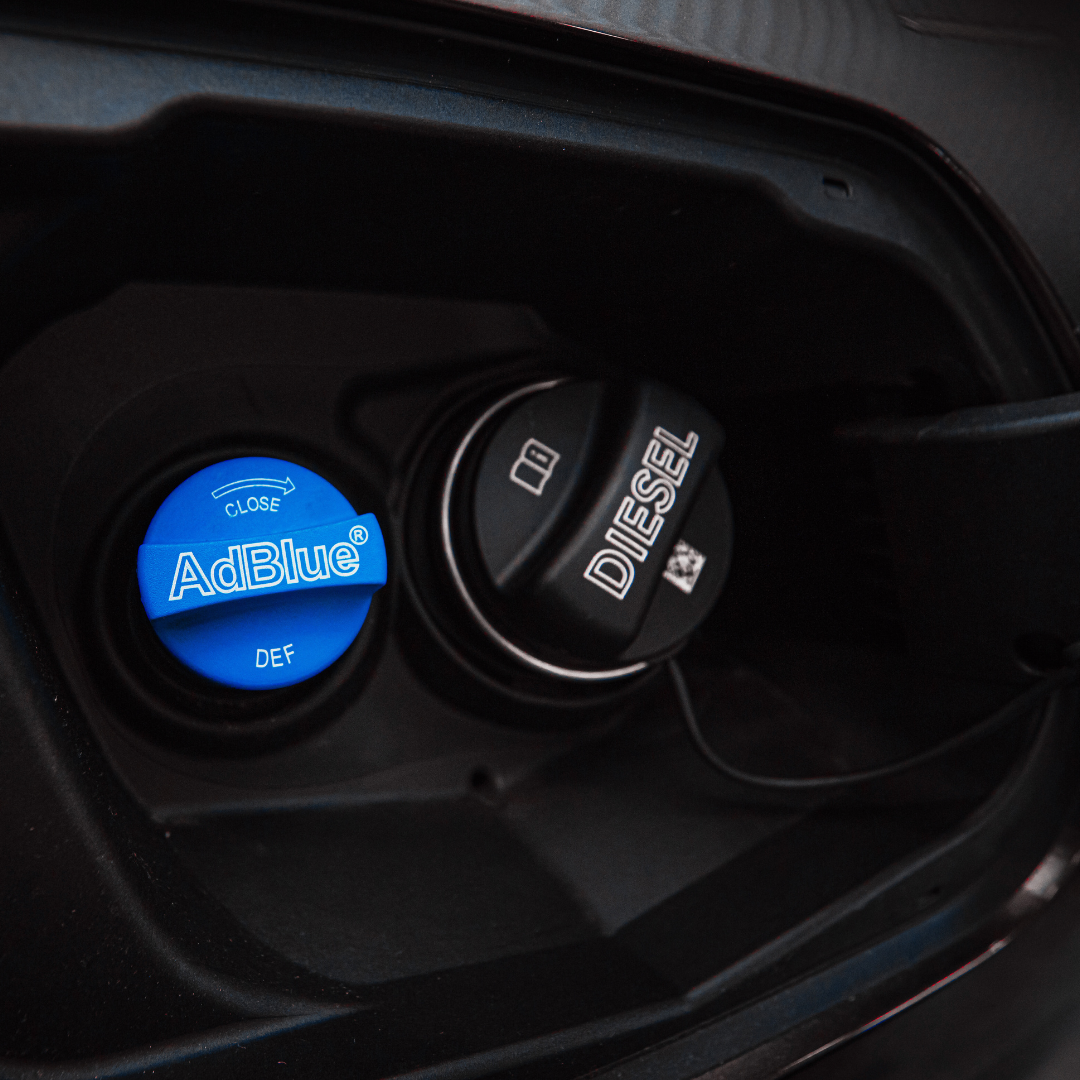
Bild på disel tanklock och adblue lock

The SCR system

The SCR system, where AdBlue has its function, is an advanced exhaust gas purification technology developed to meet strict environmental requirements, such as the EU's Euro 6 regulations. AdBlue is injected into the exhaust system before the catalytic converter, converted to ammonia and reacts with NOX. This requires the right temperature, functioning sensors and stable dosage. It is all carefully controlled by the car's engine management for the best possible effect under different driving conditions. How does it work in practice?

Common problems with AdBlue systems

The AdBlue system is good, but it can also create problems – technical ones as well as increased maintenance costs. It is a complicated system and this means that it is sensitive to a number of different factors that can affect the car's function and reliability.

Crystal formation

Another common problem is the formation of crystals in the AdBlue system. This occurs when the liquid evaporates or is used in insufficient quantities and can lead to blockage of the catalytic converter and other important components. Such blockages often require extensive and costly repairs, especially if they have caused permanent damage to the SCR catalytic converter.

Sensitivity to cold

One of the biggest weaknesses of AdBlue is that it is sensitive to low temperatures. The liquid freezes at -11 degrees and this often causes problems given the Swedish winter climate. When AdBlue freezes, the system does not work properly, which often results in the warning light coming on and, in the worst case, the engine's performance deteriorating. To avoid this type of problem, cars with AdBlue need to have a heating system, which increases the complexity even further and with it the risk of technical failures.

AdBlue Delete/Off

Many car owners believe that the AdBlue system creates more problems than it solves. If that is the case, our AdBlue off service can be a good solution to avoid frequent and expensive complications. It is about being able to rely on your car in everyday life without compromising on its function.

Repeated failures and expensive repairs

If your car suffers from constant problems related to the AdBlue system – such as error codes, warning lights or malfunctioning sensors – it can quickly become an expensive affair. Often repairs are required that are not only expensive but also involve long visits to the workshop. By programming the AdBlue monitoring off, you avoid this.

How is AdBlue Delete affecting the car?

Disconnecting the AdBlue system is a change that can bring great benefits. It positively affects the car's performance and reduces the risk of annoying warning lights and unexpected stops. For you as a driver, it provides reliable and trouble-free driving, even in demanding conditions.

Safer operation and no unauthorized engine stops

When the AdBlue system is taken out of service, there is no risk of the car going into failsafe mode or not starting at all due to sensor problems, low AdBlue level or system failure. This is especially good for those who often drive in cold climates, as the AdBlue system is sensitive to frost and requires heating to function. By deactivating the system, you avoid problems and can trust that your car will perform as you expect.

Security is not affected

AdBlue off does not affect the car's basic functions or safety. Disabling the system is done by changing the software and therefore does not require any mechanical intervention. This means that all components in the car remain intact. You get a car that operates stably without interference from the AdBlue system and is better adapted to everyday demands.

How the AdBlue Off service works

AdBlue Off is a practical and effective solution to avoid problems caused by your car's AdBlue system.
The service is designed to ensure that your car is working properly, regardless of model or make, and without compromising safety or drivability.

Software changes

The procedure involves a change in the engine control unit software. The reprogramming electronically switches off the AdBlue system without affecting any physical components. This deactivates the sensors and monitoring, eliminating the risk of warnings and limitations in the car's operation.
The programming is carried out with great precision to ensure that the car maintains its performance and that no unwanted side effects occur. Adaptations are made based on the current car model, and the procedure therefore works just as well for a smaller passenger car as for a larger commercial vehicle.

Selective catalytic reduction (SCR)

Selective catalytic reduction (SCR) is an advanced emission control technology used to reduce nitrogen oxides (NOx) emissions from internal combustion engines and industries. The technology is based on a chemical, catalytic reduction reaction that converts NOx into harmless molecules such as nitrogen gas (N₂) and water (H₂O). The reaction requires the addition of a reducing agent, such as ammonia or urea, to the exhaust gases before they pass through the catalytic converter.

The catalyst

The core of the SCR system is the catalyst, which is usually made of a porous ceramic material coated with active components such as vanadium, molybdenum or zeolites. It promotes reactions in which nitrogen oxides are reduced without significantly affecting other gases. The catalyst is designed so that it has a large surface area and enables good gas flow.

The temperature is important for the reactions to proceed efficiently. The optimal operating temperature is between 300 and 450 °C, where ammonia reacts efficiently with NOx. At lower temperatures, there is a risk of unused ammonia being released, which is undesirable. At temperatures that are too high, the catalyst material risks deteriorating and this can mean a reduced service life for the system.

Kemin bakom

The primary reaction in the SCR process is the reduction of NOx by reaction with ammonia. If urea is used, as in AdBlue, a thermal decomposition to ammonia first occurs.
However, secondary reactions can occur in the presence of sulfur or other impurities, and this can lead to the formation of ammonium sulfates that can clog the catalyst. To avoid this type of problem, special combustion techniques or filters are sometimes used before the exhaust gases reach the SCR unit.

SCR technology balances several different parameters, such as the geometry of the catalyst, the dosage of the reducing agent and the composition of the exhaust gases. The system is adapted for modern diesel engines, to meet strict emission standards such as EURO 6 and Tier 4 Final, and can reduce NOx emissions by up to 95%.

AdBlue Off

AdBlue delete is a smart solution for those who want to avoid complicated systems and high repair costs while maintaining your car's performance and safety.
We have extensive experience in handling all complicated problems that can arise in the AdBlue system.
PRICE 4900:-
Find your model and see how we can optimize your vehicle!
Tuningchip logotype
We offer each individual car a tailor-made and unique 100% customized software with a lifetime guarantee. You get exactly what it sounds like, an individually adjusted engine optimization for your unique car and your driving behavior.

*Does not apply to certain cars during campaigns. Cars that require external unlocking and must be sent away. Alfa 2.9T and McLaren or compressor wheel upgrade.
Note. KIA Stinger requires other spark plugs, additional 3990:- plugs + labor.
Join our newsletter
Optimize your inbox and get the latest offers and news.
warning for diesel boxes
STT Emtec emission & engine technology laboratory has tested diesel boxes that showed a power increase of approximately 1/3 of the promised power increase, another disadvantage was exceeding the maximum exhaust gas temperature in the turbo and too high fuel pressure.
PRIVACY POLICY
ABOUT US
Social media
warning for diesel boxes
STT Emtec emission & engine technology laboratory has tested diesel boxes that showed a power increase of approximately 1/3 of the promised power increase, another disadvantage was exceeding the maximum exhaust gas temperature in the turbo and too high fuel pressure.
Skriv in ditt nummer så
ringer vi upp dig inom kort
mellan 08.00 - 22.00.